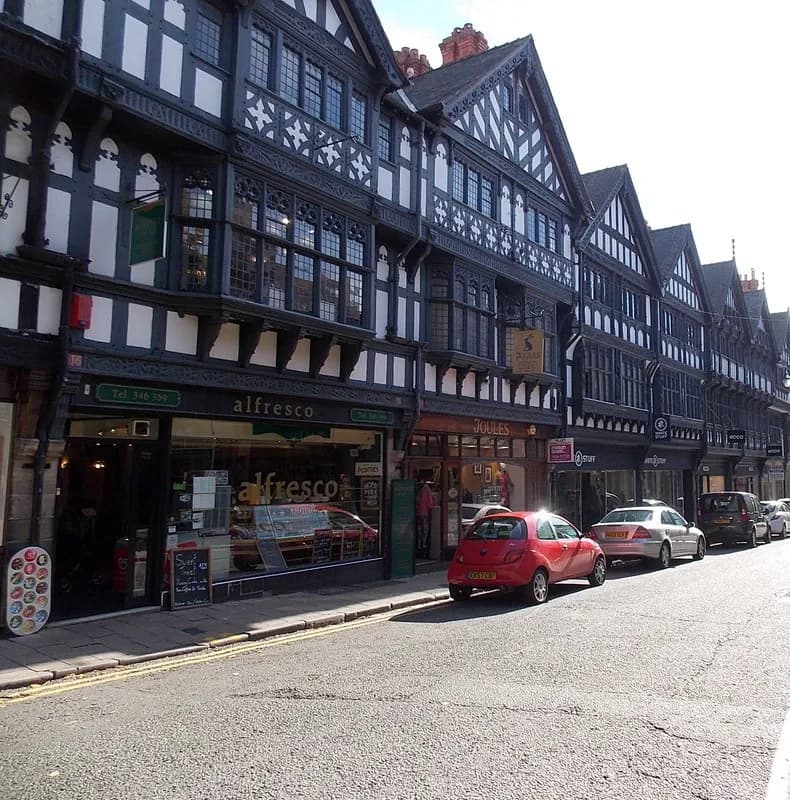
John Douglas shaped much of the Chester streetscape that visitors recognise today. Born at Park Cottage, Sandiway, Cheshire, on 11 April 1830, he spent his career working from an office in the city and produced some of its most distinctive half-timbered buildings.
Early Work and the Black-and-White Revival
Douglas established his practice in Chester and became closely associated with the Grosvenor family, the Dukes of Westminster, whose patronage underpinned many of his commissions. His first known use of black-and-white half-timbering came with the entrance lodge to Grosvenor Park, built between 1865 and 1867. The project marked the beginning of his contribution to Chester's Victorian black-and-white revival, a movement that drew on the city's existing medieval vernacular while reinterpreting it for a new era.
Key Buildings in Chester
Among his most prominent Chester works is the range at 2–18 St Werburgh Street, where highly detailed timber-framed upper storeys, oriel windows, and gables create one of the city's most distinctive street fronts. Between approximately 1879 and 1881 he built a terrace of houses at 6–11 Grosvenor Park Road on land he owned himself. In Eastgate Street, the former Grosvenor Club and North and South Wales Bank, completed in 1881–83, displays stone and brickwork with a turret and stepped gable. Douglas also designed premises for the Cheshire County Constabulary at 142 Foregate Street in 1884.
Distinctive Architectural Details
Douglas's buildings are readily identified by a number of recurring features. He made extensive use of half-timbering, tile-hanging, pargeting, and decorative brick diapering. His tall chimney stacks, often twisted, remain a familiar sight above Chester rooflines. Other hallmarks include dormer windows rising through eaves and surmounted by hipped roofs, together with Dutch gables. He paid particular attention to joinery and wood carving, both externally and internally.
The Eastgate Clock and Later Career
In 1897, working in partnership with Charles Minshull as Douglas & Minshull, he designed the Eastgate Clock. It has become one of Chester's most photographed landmarks. Douglas died on 23 May 1911, aged 81. An obituary in the Chester Chronicle recorded that he "lived heart and soul in his profession". The Duke of Westminster's secretary offered a more pointed assessment in 1884, reportedly remarking that Douglas was "a good architect but a poor hand at accounts".
Legacy on the Streets of Chester
Many of Douglas's buildings remain in daily use, contributing to the city's architectural character. In 1923 his former pupils and assistants placed a commemorative plaque on one of his St Werburgh Street buildings. Historic England listings confirm a substantial number of surviving Douglas structures across the city. His Victorian-era reinterpretation of Chester's medieval black-and-white tradition helped fix the style as the city's visual signature.